

Banks Open on Saturday in the US: Branch Times and Weekend Rules
What Is a Factor Rate? Meaning for Merchant Cash Advances and Business Loans
Author:
Aaron Klein
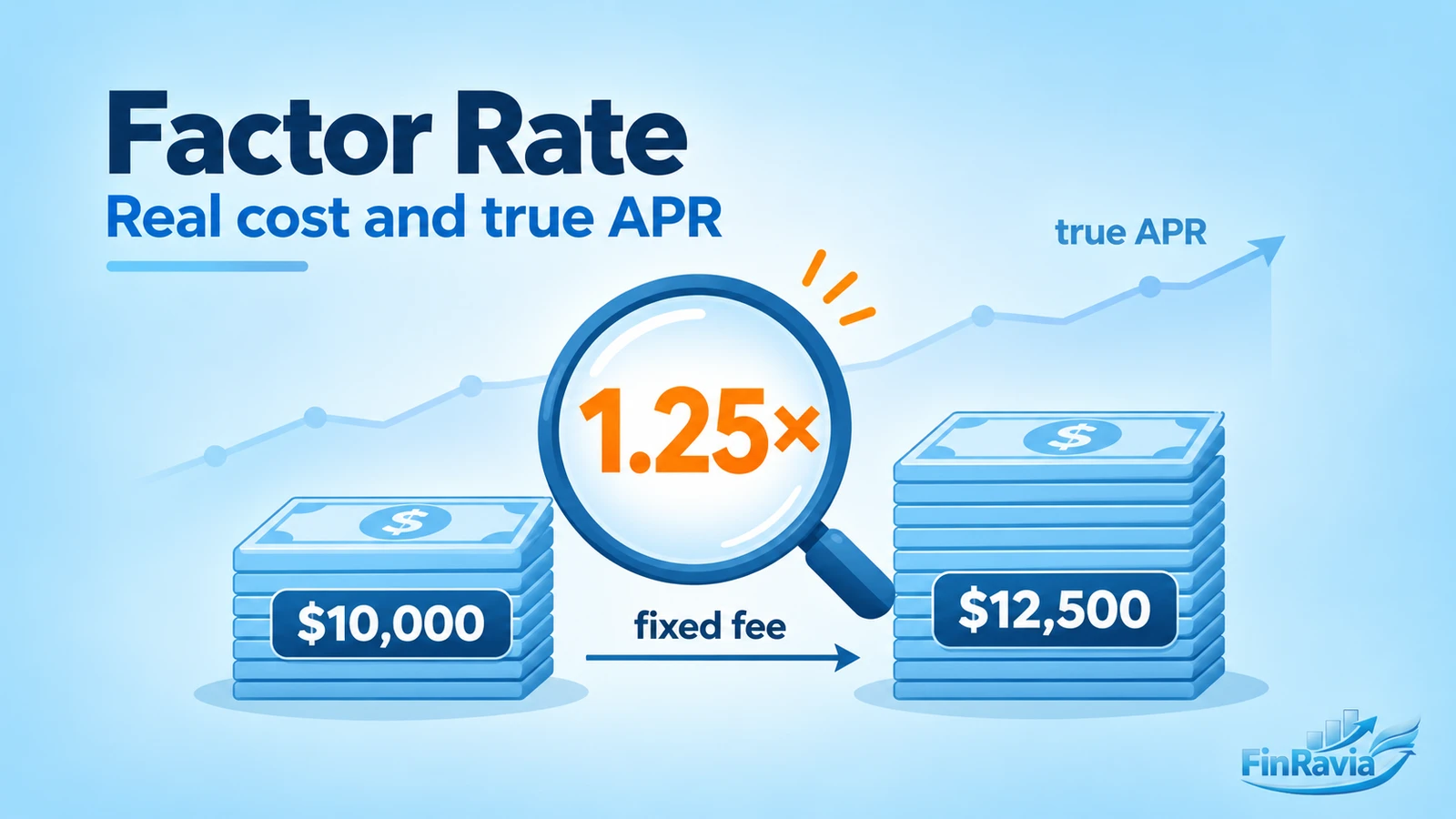
A factor rate is a decimal multiplier that sets the total you repay on a merchant cash advance or short-term business loan: a $10,000 advance at 1.25 costs $12,500, and that $2,500 fee is fixed the day you sign. Because the provider charges the fee once on the full amount, the multiplier tells you the dollar cost but not the yearly cost. Below, you will find the formula, a ready-made cost table and a way to turn any offer into an APR you can compare with a bank loan.
Contents
- Multiplier Pricing: How One Fixed Fee Works
- Multiplier Math: The Cost Formula and Examples
- Factor Rate vs Interest Rate: Where the Cost Difference Comes From
- Factor Rate to APR: How to Convert It
- How Mexico Forces One All-In Number: CAT
- Multiplier Ranges and What Moves Your Quote
- Merchant Cash Advance Pitfalls: When to Walk Away
- APR, Cost and Debit: Comparing Two Offers
- APR Method and Sources Behind These Figures
Multiplier Pricing: How One Fixed Fee Works
A factor rate is a flat multiplier applied once to the whole advance: at 1.25, you repay $1.25 per $1. The multiplier never touches a shrinking balance, so you know the fee the day you sign. Merchant cash advances are the most common product priced this way, followed by short-term working capital loans and some revenue-based financing. Factor rates require only three numbers to describe any of these offers:
- Advance: the cash the provider sends you.
- Total repayment: the advance times the multiplier, also called the payback amount.
- Cost of capital: total repayment minus the advance, the provider’s fee in dollars.
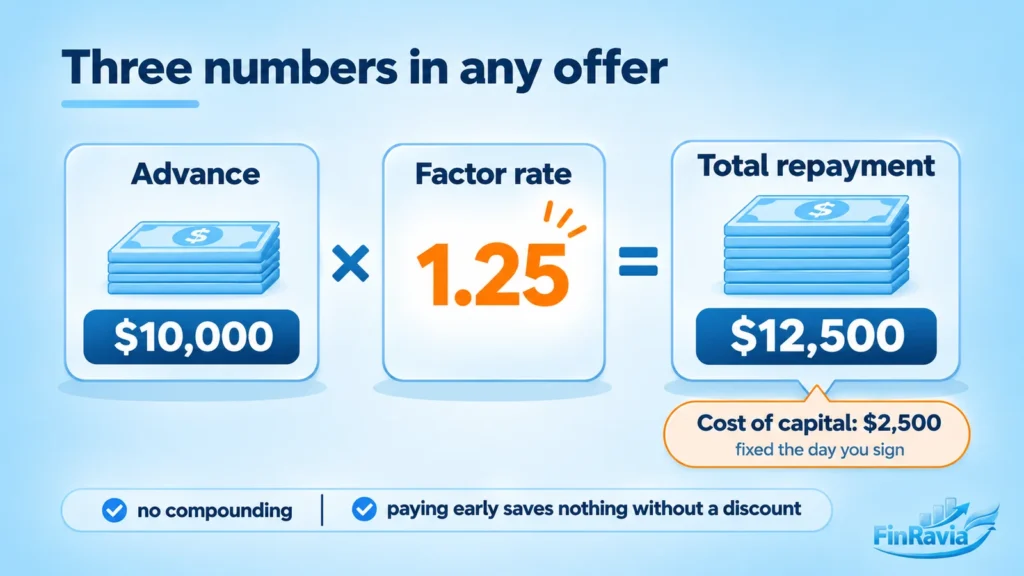
The fee does not compound and does not grow if repayment takes longer. It also does not shrink if you finish early, unless the contract includes an early payoff discount. Some providers call the same number a buy rate or a rate factor.
A merchant cash advance works as a purchase of your future card or bank receipts, so repayment usually comes as a fixed daily or weekly debit, or as a share of each day’s sales.
⚠️ Not to be confused with: the “interest rate factor” that federal student loan servicers use. That figure is your annual interest rate divided by 365.25 days, and it measures daily interest on a balance. It has nothing to do with business advances.
With the mechanics clear, the next step is the arithmetic behind every offer.
Multiplier Math: The Cost Formula and Examples
A factor rate of 1.20 on a $10,000 advance costs $2,000: multiply the advance by the multiplier, then subtract the advance. The multiplier and the advance are the only inputs, so two lines cover every case:
text{Total repayment} = text{Advance} times text{Factor rate}
text{Cost of capital} = text{Advance} times (text{Factor rate} – 1)
The table below prices each multiplier on two typical advance sizes.
| Factor rate | Total repaid on $10,000 | Cost on $10,000 | Total repaid on $50,000 | Cost on $50,000 |
|---|---|---|---|---|
| 1.10 | $11,000 | $1,000 | $55,000 | $5,000 |
| 1.20 | $12,000 | $2,000 | $60,000 | $10,000 |
| 1.30 | $13,000 | $3,000 | $65,000 | $15,000 |
| 1.40 | $14,000 | $4,000 | $70,000 | $20,000 |
| 1.50 | $15,000 | $5,000 | $75,000 | $25,000 |
A multiplier of 1.3 instead of 1.2 adds 10 cents of cost to every dollar funded, or $5,000 on $50,000.
Multiplier on the cash you actually receive
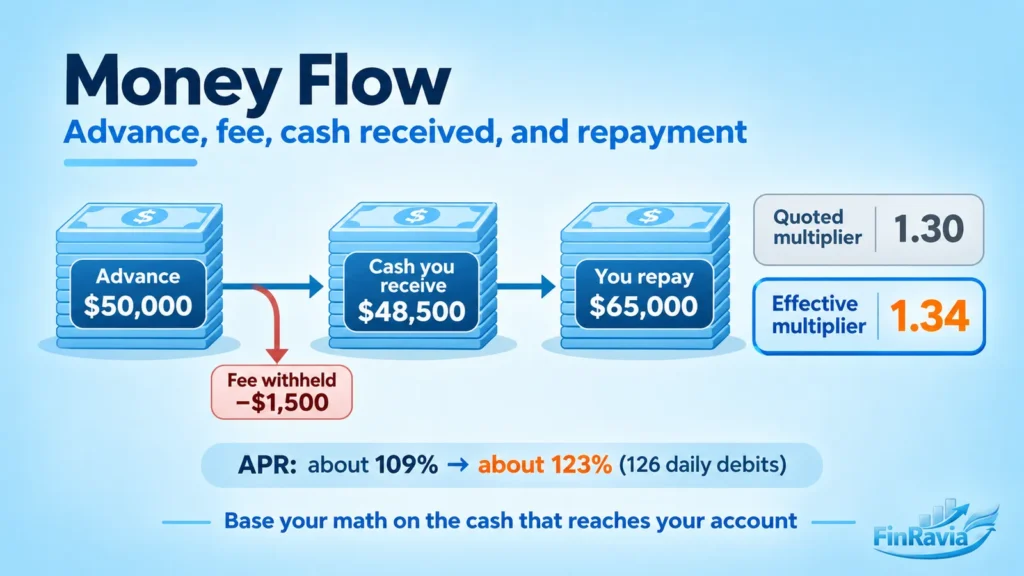
If the provider takes an origination or underwriting fee out before the money arrives, base your math on the cash that actually reaches your account. The multiplier stays at 1.30 on a $50,000 advance with a $1,500 fee withheld, yet you receive only $48,500 and still repay $65,000. The effective multiplier on the cash you can use is 1.34, not 1.30, and your real cost is $16,500.
Work out the payment
Divide the total repayment by the number of scheduled payments. A $65,000 payback spread over about six months of business days (126 debits) means roughly $515.87 leaves your account every business day. That daily figure matters as much as the total, which is why the next section compares this structure with an interest-bearing loan.
Factor Rate vs Interest Rate: Where the Cost Difference Comes From
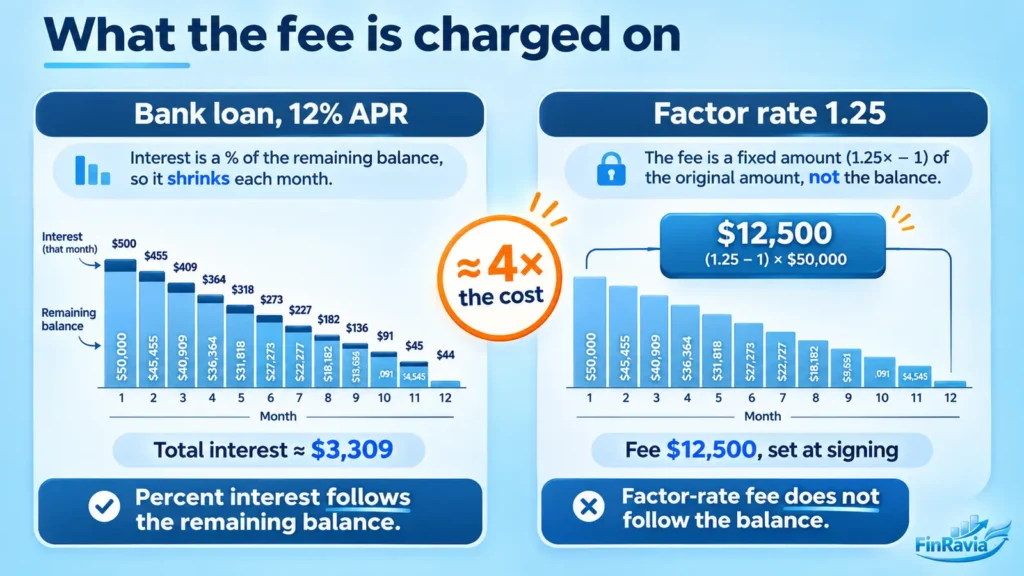
An interest rate charges on the balance still owed; a factor rate of 1.25 charges its full fee up front. Factor rates charge that fee once, so paying early saves nothing unless a discount applies. The interest rate on a loan works the other way: each payment cuts the principal, so less interest builds in the next period.
| Feature | Factor rate | Interest rate |
|---|---|---|
| Written as | A decimal, such as 1.25 | A percentage, such as 12% |
| Charged on | The original advance, once | The remaining balance, each period |
| Total cost known at signing | Yes | Only if you follow the schedule |
| Paying early | Saves nothing unless a discount applies | Cuts the interest you pay |
| Annual comparison number | Not required under Regulation Z for business credit; some states require an estimated APR | APR, disclosed on consumer loans under federal rules |
An APR comparison makes the gap concrete: a $50,000 bank term loan at 12% APR over 12 monthly payments costs about $3,309 in interest. A 1.25 multiplier on the same $50,000 costs $12,500, almost four times as much.
❌ Factor rate myth: 1.25 does not mean 25% interest. The 0.25 is a one-time charge for the whole term, so the yearly rate depends on how fast you repay. Over six months of daily payments it works out to about 92% APR.
The two systems price different structures, which is why you need a conversion before you compare them.
Factor Rate to APR: How to Convert It
A factor rate converts to APR in two steps: find the periodic rate your payment schedule implies, then annualize it. The APR shortcut most calculators show divides the fee by the term in years. An APR built that way treats you as if you kept the full advance until the last day.
- Multiplier minus 1 gives the fee per dollar: 1.25 − 1 = 0.25.
- The APR shortcut divides that fee by the term in years: 0.25 ÷ 0.5 = 50% for six months.
- APR comes from the payment schedule: in Excel or Google Sheets, use =RATE(number of payments, −payment, net cash received) and multiply by the payments per year.
- For a $10,000 advance at 1.25 repaid in 126 daily debits of $99.21, enter =RATE(126, −99.21, 10000) × 252. The result is about 92%.
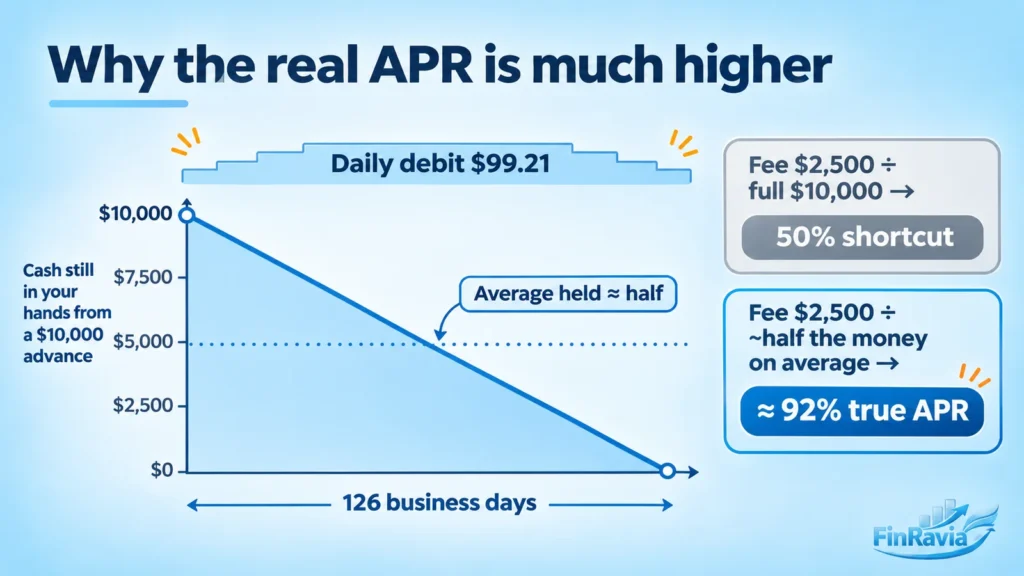
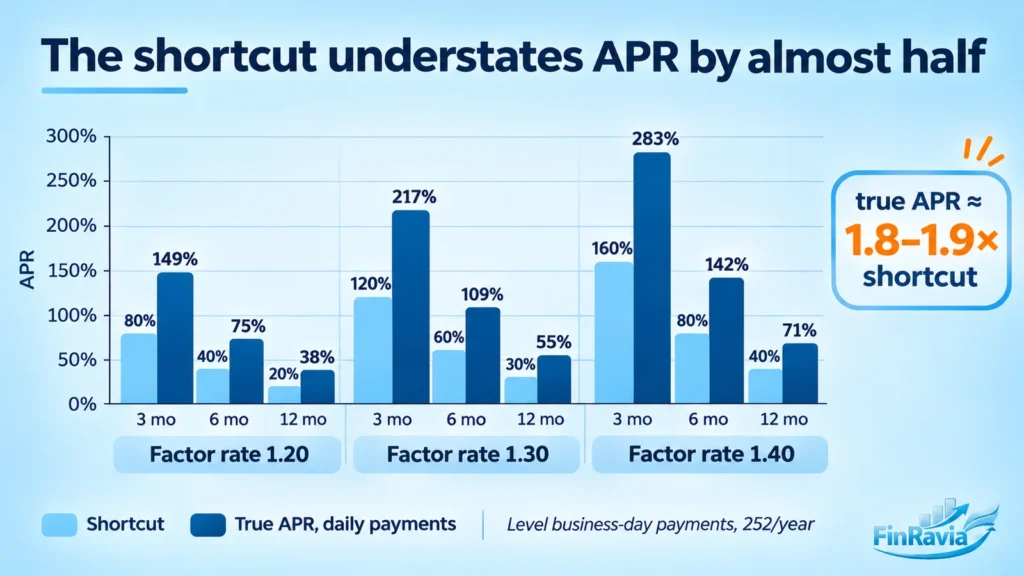
Because you repay part of the balance every day, you hold on average only about half the money over the term. That is why the true APR comes out roughly 1.8 to 1.9 times the shortcut figure. Factor rates of the same size convert to very different APRs depending on the term:
| Factor rate | Term | Shortcut annual rate | True APR, daily payments |
|---|---|---|---|
| 1.20 | 3 months | 80% | 149% |
| 1.20 | 6 months | 40% | 75% |
| 1.20 | 12 months | 20% | 38% |
| 1.30 | 3 months | 120% | 217% |
| 1.30 | 6 months | 60% | 109% |
| 1.30 | 12 months | 30% | 55% |
| 1.40 | 3 months | 160% | 283% |
| 1.40 | 6 months | 80% | 142% |
| 1.40 | 12 months | 40% | 71% |
Fees push the APR higher still. The $50,000 advance at 1.30 with $1,500 withheld, repaid over 126 business days, comes to about 123% APR instead of 109%.
In California and New York, many providers must now show an estimated APR on commercial financing offers, including sales-based financing such as merchant cash advances. Ask for that figure in writing, and check it against your own RATE calculation. Mexico goes further and makes one all-in number mandatory, which is why its rule deserves a closer look.
How Mexico Forces One All-In Number: CAT
In Mexico, a lender cannot advertise credit with only a factor rate or a bare interest rate. The Ley para la Transparencia y Ordenamiento de los Servicios Financieros requires the CAT (Costo Anual Total) in advertising and in the contract, and Banco de México sets how it is calculated.
Banco de México’s CAT strips out IVA, so borrowers can comparar préstamos en línea en México por CAT, one annual figure that covers interest and fees, instead of reading every contract line by line. Two offers with different fee structures land on the same scale before anyone signs.
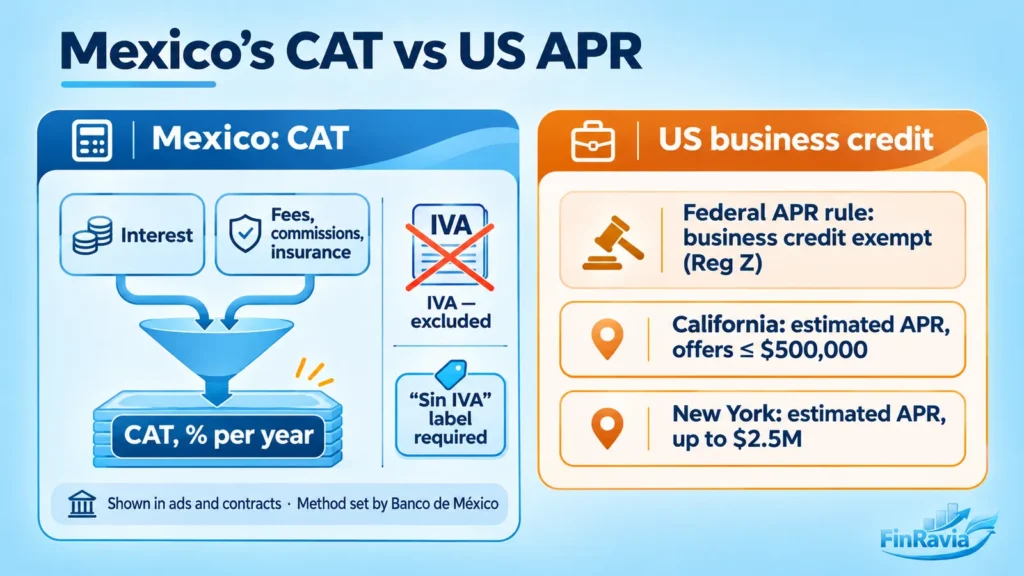
US small-business borrowers have no single federal equivalent. The closest analog is the estimated APR that California and New York require on many commercial financing offers. The next question is what multiplier you are likely to be offered in the first place.
Multiplier Ranges and What Moves Your Quote
A multiplier 0.1 higher adds $1,000 of cost per $10,000 and about 16 to 18 points of APR over 12 months. The multiplier you get reflects how risky the provider judges your business and how fast it expects to be repaid. Factor rates that major comparison guides report as typical cost 10 to 50 cents per dollar, or 1.1 to 1.5, though offers outside that band exist.
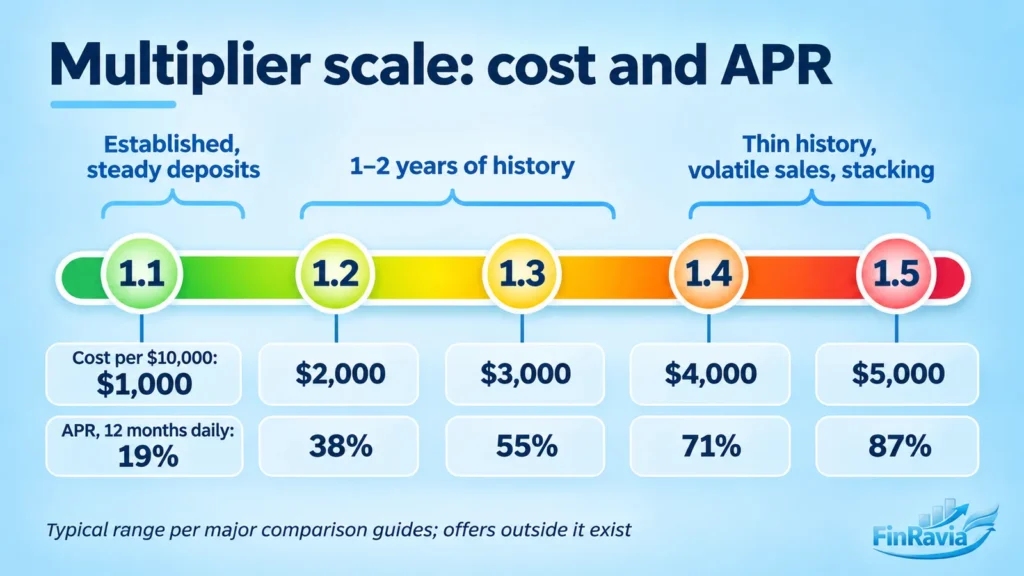
- 1.1 multiplier: you repay $1.10 per dollar, so $20,000 costs $2,000. That multiplier usually goes to established businesses with strong, steady deposits.
- Multipliers of 1.2 to 1.3: you repay $1.20 to $1.30 per dollar. This is where many offers for businesses with a year or two of history sit.
- Multipliers of 1.4 and above: you repay $1.40 or more per dollar. Expect this with thin history, volatile sales or a second advance on top of an open one.
Providers usually weigh these inputs:
- Time in business: a longer track record usually earns a lower multiplier, and newer businesses often need about $10,000 or more in monthly sales to qualify.
- Deposits: steady, high daily card and bank receipts mean faster, more certain repayment.
- Industry: seasonal or cyclical sectors, such as restaurants and construction, often see higher multipliers.
- Credit history: it matters less than with a bank, but a stronger score can still lower the quote.
- Existing advances: an open advance on the same receipts usually raises the rate on a new one.
- Term length: a longer expected repayment often comes with a higher multiplier.
Factor rates can also come down: a smaller requested amount, competing offers or proof of steady deposits cuts the fee you are quoted. However, even a low quote can be the wrong deal, as the cases below show.
Merchant Cash Advance Pitfalls: When to Walk Away
Factor rates cost the most when cheaper credit exists: $50,000 at a 1.25 multiplier costs $12,500, against about $3,309 at 12% APR. A multiplier is also a poor fit when the daily debit outruns your slowest weeks. Merchant cash advances fail the test in five common cases:
- You qualify for a bank or SBA loan and can wait. If you can wait for a bank decision instead of a same-day advance, the example above leaves you about $9,200 better off.
- The daily debit exceeds what your slowest month can carry. A $65,000 payback over 126 business days takes $515.87 every business day. If your slowest month leaves less than that per day after payroll, rent and inventory, the offer will strain cash flow regardless of its price.
- You plan to repay early to save money. Without an early payoff discount, finishing a 12-month advance at 1.25 in six months saves nothing. The dollar cost stays $2,500 per $10,000, and the effective APR roughly doubles, from about 46% to about 92%.
- You would take a second advance to cover the first. Stacking a $20,000 advance at 1.35 over six months adds $7,000 of cost and another $214.29 a day on top of the existing debit.
- The money will earn less than the fee. A 1.25 advance only pays off if the funded project returns more than 25 cents per dollar before the last payment. Inventory that sells at a 20% gross margin once in that window loses money.
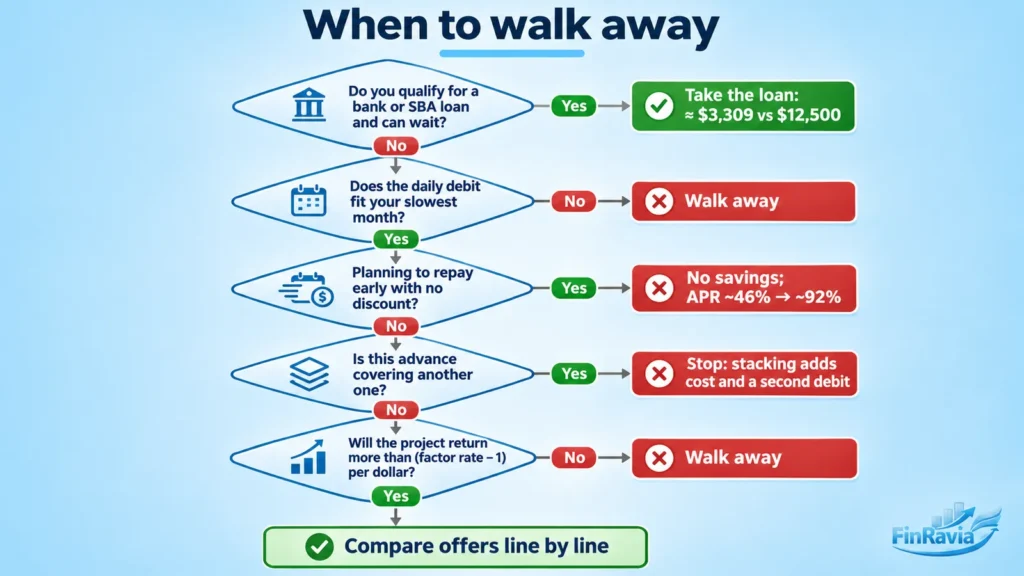
If none of these cases applies, the next step is to compare offers line by line.
APR, Cost and Debit: Comparing Two Offers
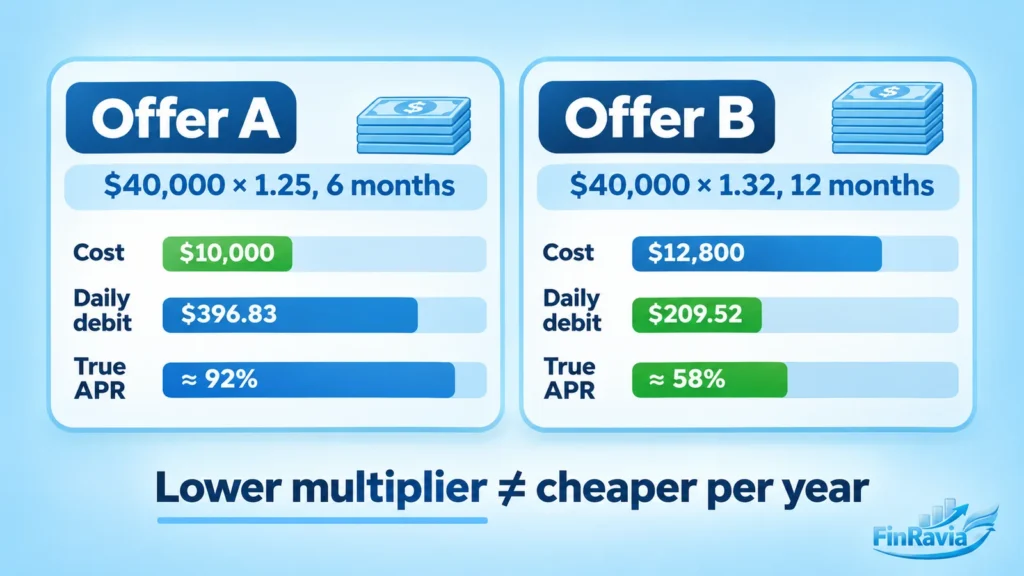
A lower multiplier can cost more per year: 1.25 over 6 months is about 92% APR, 1.32 over 12 months about 58%. The APR, the dollar cost and the daily debit belong on the same grid for every offer. Merchant cash advance quotes show the difference best side by side:
| Line | Offer A | Offer B |
|---|---|---|
| Advance | $40,000 | $40,000 |
| Multiplier | 1.25 | 1.32 |
| Total repayment | $50,000 | $52,800 |
| Cost in dollars | $10,000 | $12,800 |
| Term | 6 months (126 debits) | 12 months (252 debits) |
| Daily payment | $396.83 | $209.52 |
| True APR | about 92% | about 58% |
Offer A costs $2,800 less in dollars but nearly twice as much per year, and its daily debit is almost double. The APR matters less than the debit when cash flow is the constraint, so Offer B is the safer choice there. The multiplier matters more when the money returns quickly: if the larger debit fits, Offer A spends less in total.
Before you accept any offer, get written answers to these questions:
- How much reaches my account after every fee?
- What is the total repayment in dollars?
- How much is each debit, and is it daily, weekly or a share of sales?
- How long is the estimated term?
- What happens if my sales drop, and how do I request an adjustment?
- Is there an early payoff discount, and how does the provider calculate it?
- What is the estimated APR, and how did the provider compute it?
Pros and cons of fixed-fee pricing
| Pros | Cons |
|---|---|
| The dollar cost is fixed and known at signing | Usually far more expensive than bank or SBA credit |
| Funding can arrive the same day you apply | Paying early rarely lowers the cost |
| Approval leans on deposits more than credit score | Daily or weekly debits can squeeze cash flow |
| Sales-based repayment can slow down when revenue drops | Not covered by federal APR disclosure rules |
Before you sign, also check how we built the figures on this page.
APR Method and Sources Behind These Figures
An APR on this page assumes level payments on 252 business days a year; we checked every figure on November 3, 2026. The APR excludes fees unless an example says so. Merchant cash advance quotes you receive will differ: these figures are illustrations, not offers, and real terms vary by provider and agreement.
The legal points rest on primary rules and their published summaries:
- Federal rules: Regulation Z, which carries out the Truth in Lending Act, exempts credit made primarily for a business purpose under 12 CFR 1026.3(a). Federal APR disclosure therefore does not reach business advances.
- Merchant cash advances: these work as purchases of future receivables, and usury limits apply only to loans. New York’s Appellate Division weighs three factors to decide whether repayment is truly contingent: a reconciliation provision, a finite term, and recourse if the merchant goes bankrupt (LG Funding v. United Senior Properties, 2020). Courts can treat an agreement that demands repayment no matter what happens to sales as a loan.
- California: since December 9, 2022, the Department of Financial Protection and Innovation requires disclosures, including an APR (estimated for sales-based financing), on commercial financing offers of $500,000 or less, merchant cash advances included. SB 33, signed in October 2023, made the annualized-rate requirement permanent.
- New York: since August 1, 2023, the Department of Financial Services requires similar disclosures on commercial financing of up to $2.5 million; for sales-based financing the disclosure table must show an Estimated Annual Percentage Rate (23 NYCRR 600.6).
- Mexico: articles 8 and 15 of the transparency law require the CAT in advertising and adhesion contracts; Banco de México Circular 21/2009 sets the method, excludes IVA and requires the “Sin IVA” label next to the figure.
This page explains how pricing works and is not financial or legal advice; compare offers with an accountant or adviser before you sign.
Sources
Frequently asked questions
What does it mean when an offer quotes 1.3?
A 1.3 multiplier means you repay $1.30 for every dollar advanced. That multiplier turns $20,000 into $26,000 owed, a $6,000 cost however long repayment takes.
Is a 1.25 factor rate the same as 25% interest?
No. A 1.25 multiplier charges 0.25 once for the whole term, not each year. Repaid daily over six months, a 1.25 multiplier equals about 92% APR; over 12 months, about 46%.
How do I turn the multiplier into an APR?
Use your payment schedule: =RATE(number of payments, −payment, net cash received) × payments per year. Dividing the fee by the term in years is a shortcut that understates the true APR by almost half.
Does paying early lower the cost?
Usually not. The provider fixes the fee at signing, so finishing early only helps if the contract includes an early payoff discount. Ask for the discount terms in writing.
What does a 1.1 factor rate mean on a business loan?
You repay $1.10 for every dollar, so a $20,000 loan costs $2,000. Over a 12-month term with daily payments, that is about 19% APR.
Do banks price loans this way?
Rarely. Banks, credit unions and SBA lenders price term loans and lines of credit with interest rates and an APR. Factor rates show up mainly in offers that online and alternative providers fund.
Is a merchant cash advance a loan?
Usually not, as long as repayment truly depends on your sales. It works as a purchase of future receivables and sits outside federal truth-in-lending rules, but courts can treat an agreement as a loan if you must repay regardless of sales.
What is the interest rate factor on a student loan?
It is a different measure: the loan's annual interest rate divided by 365.25 days. Federal student aid guidance multiplies the outstanding principal by that factor and by the days since the last payment to get accrued interest.