What Is Selfie ID Verification — and Why Do Lenders Require It?
Micro Deposit Verification, Explained
Author:
Aaron Klein
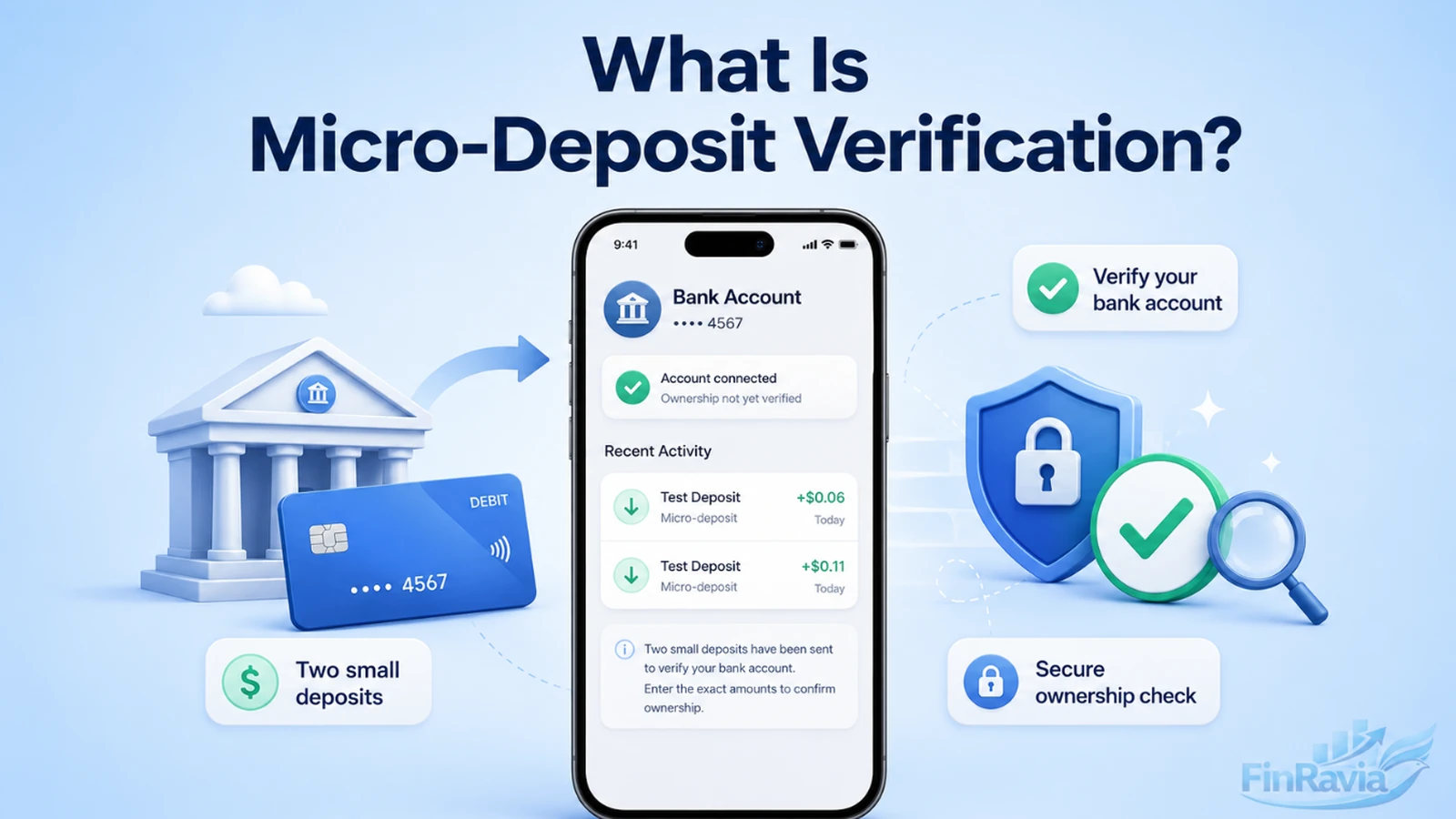
Micro deposit verification confirms that you own a bank account by sending one or two small test payments, usually under a dollar, which you then confirm through the requesting service to prove you can access the account before it processes larger transfers.
Contents
Quick facts:
- Amount — Usually under $1 per deposit — These two small micro deposits prove you control the account without ever exposing your online banking password.
- Timing — Typically 1–3 business days — Deposits usually post within a few working days, though the exact window depends on your bank and the service that sent them.
- Purpose — Confirms account ownership — Matching the exact amounts is what completes micro deposit verification and unlocks transfers or payments.
Next, here’s what the term actually means and how the process plays out step by step.
What Is Micro Deposit Verification?
Micro deposit verification is a bank-linking method that proves account ownership through two small test deposits instead of a shared password. A service that needs to move money into or out of your bank account — a payroll platform, a lending app, an investment account, a peer-to-peer payment tool — first has to confirm the account and routing numbers you typed in actually belong to you. Rather than asking for your online banking login, it sends two small micro deposits, often just a few cents apiece, into the account. You then check your statement, note the exact amounts, and type them back into the service. A match proves ownership; a mismatch blocks the link.
You’ll also see micro deposit verification called microdeposit verification or micro-deposit verification — with or without the space, all three spellings describe the same mechanism. This approach sits alongside other account-verification methods, but it remains common precisely because it works with almost any bank that can receive an electronic transfer, regardless of size or technology.
How the Verification Process Works
The micro deposit verification process runs through five predictable steps from account entry to full activation. The mechanics are largely the same across providers, even though the interface differs.
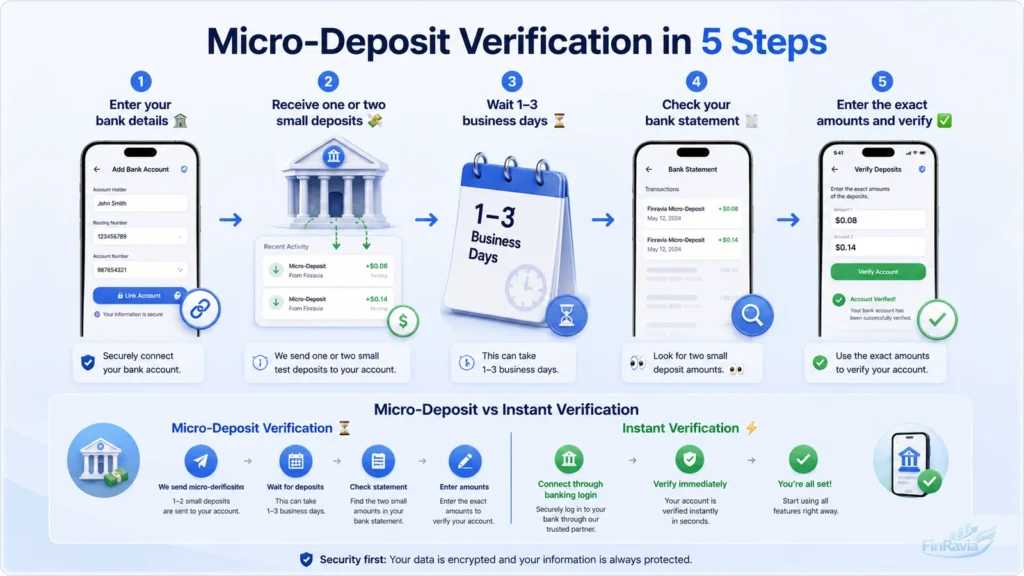
- Enter your account details. You provide your bank account number and routing number to the service you’re trying to link.
- The service sends one or two small deposits. Each is typically under a dollar, and some providers use randomized cent amounts specifically so they can’t be guessed.
- You wait for the deposits to post. This step usually takes one to three business days, depending on your bank’s processing schedule and whether the sender uses standard or same-day transfer rails.
- You check your bank statement or app. Look for two small, separate line items, often labeled something like “verification deposit” or a short reference code.
- You enter the exact amounts back into the service. If they match what was actually deposited, the account is verified and activated for transfers; if the account isn’t confirmed within a limited number of attempts, most services fall back to a different verification method.
Some providers reverse the microdeposits afterward, and some simply leave them in your account — either way, the amounts are too small to matter financially; their only job is proving you can see your own statement.
Not every micro deposit verification flow works the same way, though. The steps above describe the more common two-amount version, but some services — including a couple of large payment platforms — send a single small deposit with a short verification code embedded in the transaction description instead. Rather than typing back two dollar figures, you copy that code from your bank statement and paste it into the service. Both versions of micro deposits prove the same thing — that you can see your own account activity — they just package the proof differently. Once you know what the process looks like end to end, the next useful question is how it stacks up against the other ways banks verify an account.
Micro Deposits vs. Other Bank Verification Methods
Micro deposit verification trades speed for broader compatibility and stronger user privacy than several faster alternatives. Choosing between methods usually comes down to how fast you need the link active and how comfortable you are sharing banking credentials with a third party.
| Method | Speed | What it asks for | Trade-off |
|---|---|---|---|
| Microdeposits | 1–3 business days | Account + routing number only | Slower, but works with virtually any bank and never touches your login |
| Instant login verification | Seconds | Online banking username and password | Fast, but requires trusting a third party with your credentials |
| Bank API integration | Seconds | Nothing extra from you; bank-to-bank data exchange | Fastest and most secure, but only available where the bank supports it |
| Prenoted test checks | Several days | A voided or written check | Familiar to some users, but slower and increasingly rare |
| Credit pull | Instant to same day | Identity details for a soft/hard credit check | Fast, but can affect your credit score and raises privacy questions |
Micro deposits prove account control, while identity verification for bank accounts, credit cards and loans confirms the applicant’s legal identity. Micro deposits tend to work well for smaller banks and credit unions that lack direct data connections.
Is It Safe? Common Micro-Deposit Scams to Watch For
Legitimate micro deposit verification never asks for your online banking password, card number, or full identity documents. The process only needs your account and routing numbers, which appear on every check and are not, by themselves, enough to move money out of your account. Because these transfers move through the regulated ACH network under NACHA’s operating rules and Federal Reserve oversight, a legitimate microdeposit always leaves a traceable transaction record tied to a real, registered sender — which is exactly what fraudulent versions try to fake or avoid.
That said, the mechanism has been copied by scammers — and the twist is worth understanding precisely, because it runs backward from what most people assume. A scammer who already has your account and routing number, usually from a data breach or a stolen check image, uses those details to start their own account-linking request against your account — not yours to request, theirs. Your bank sends the small test deposits into your real account exactly like it would for any legitimate link. The scammer’s last step is contacting you directly — by phone, text, or email, posing as your bank, a payment app, or even a government agency — and asking you to read back the exact amounts you see. Handing those numbers over completes the verification the scammer started: the amounts function like a one-time passcode, and whoever has them controls the link — and can trigger unauthorized transfers out of the account.
A legitimate verification deposit never requires you to pay a fee, share your online banking password, or confirm your full card number — and you only ever type the deposit amounts yourself, directly into the service you’re linking. If anyone contacts you first and asks you to read those amounts back over the phone, by text, or by email, that’s not micro deposit verification. That’s the scam.
A separate, simpler version skips the phone call entirely: a fake “micro deposit verification site” just asks upfront for far more than an account number — a Social Security number, a full online banking login, or a “processing fee” to release the deposit. Neither step is ever part of a legitimate flow.
If you don’t recognize a service that supposedly sent you a microdeposit, don’t guess or reuse an old code from memory. Log in to your bank directly, review the transaction description, and only enter the amounts back into an account-linking flow you started yourself. Instead of panicking over an unfamiliar line item, though, it helps to first check whether it matches one of the ordinary, non-scam reasons a small deposit shows up unannounced.
Why You Might See an Unexpected Small Deposit on Your Statement
A stray deposit under a dollar is usually tied to an account-linking attempt you started and may have forgotten about, not fraud. Signing up for a budgeting app, applying for a loan, setting up payroll, or reconnecting a bank account can trigger this kind of test payment. Some services also verify account ownership before enabling recurring payments from a bank account, especially when instant verification is unavailable.
The description on your statement is the fastest way to identify the source: it often includes a short reference code, an abbreviated company name, or the words “verify” or “trial deposit.” For example, a large payment platform such as Stripe processes verification deposits on behalf of many different businesses, so the line item may reference the platform itself rather than the company you actually signed up with.
If you genuinely can’t connect the deposit to anything you did — no recent signups, no pending applications — treat it as unrecognized activity: contact your bank, ask them to flag the transaction, and watch the account closely for a follow-up debit.
Not to be confused with: a formal “verification of deposit” (VOD) is a different, paper-based document that lenders request from your bank — typically for a mortgage application — to confirm your balance and account history. It has nothing to do with the small test payments used to link a bank account electronically.
Even once you’ve traced a stray deposit back to something harmless, it’s worth knowing that this verification method still isn’t the right call in every situation.
When This Method Isn’t the Right Choice
Micro deposit verification stops being practical whenever a linked account needs to be usable the same day. A few concrete situations where it falls short:
- You need funds to move within hours, not days. Because confirmation takes 1–3 business days before the link even activates, it’s a poor fit for one-time emergency transfers or time-sensitive bill payments.
- The account holder can’t check their statement promptly. If nobody will log in to online banking for a week or more, the deposits can go unconfirmed and the request will expire.
- The bank doesn’t support standard ACH deposits. Some prepaid cards and a handful of smaller institutions can’t receive the small test payments at all, which rules the method out entirely.
- You’re linking more than a couple of accounts at once. Confirming several sets of microdeposit amounts by hand becomes tedious fast; an API-based or instant login method scales better for multiple accounts.
- Privacy about account activity matters more than avoiding a login share. Ironically, some users prefer instant credential-based verification specifically because it skips the multi-day window where a pending, unconfirmed link sits open.
Sources
Facts on this page — deposit size, typical timing, the confirmation mechanism, and the scam patterns described above — were cross-referenced against these trusted, non-commercial sources: