Micro Deposit Verification, Explained
What Is Selfie ID Verification — and Why Do Lenders Require It?
Author:
Aaron Klein
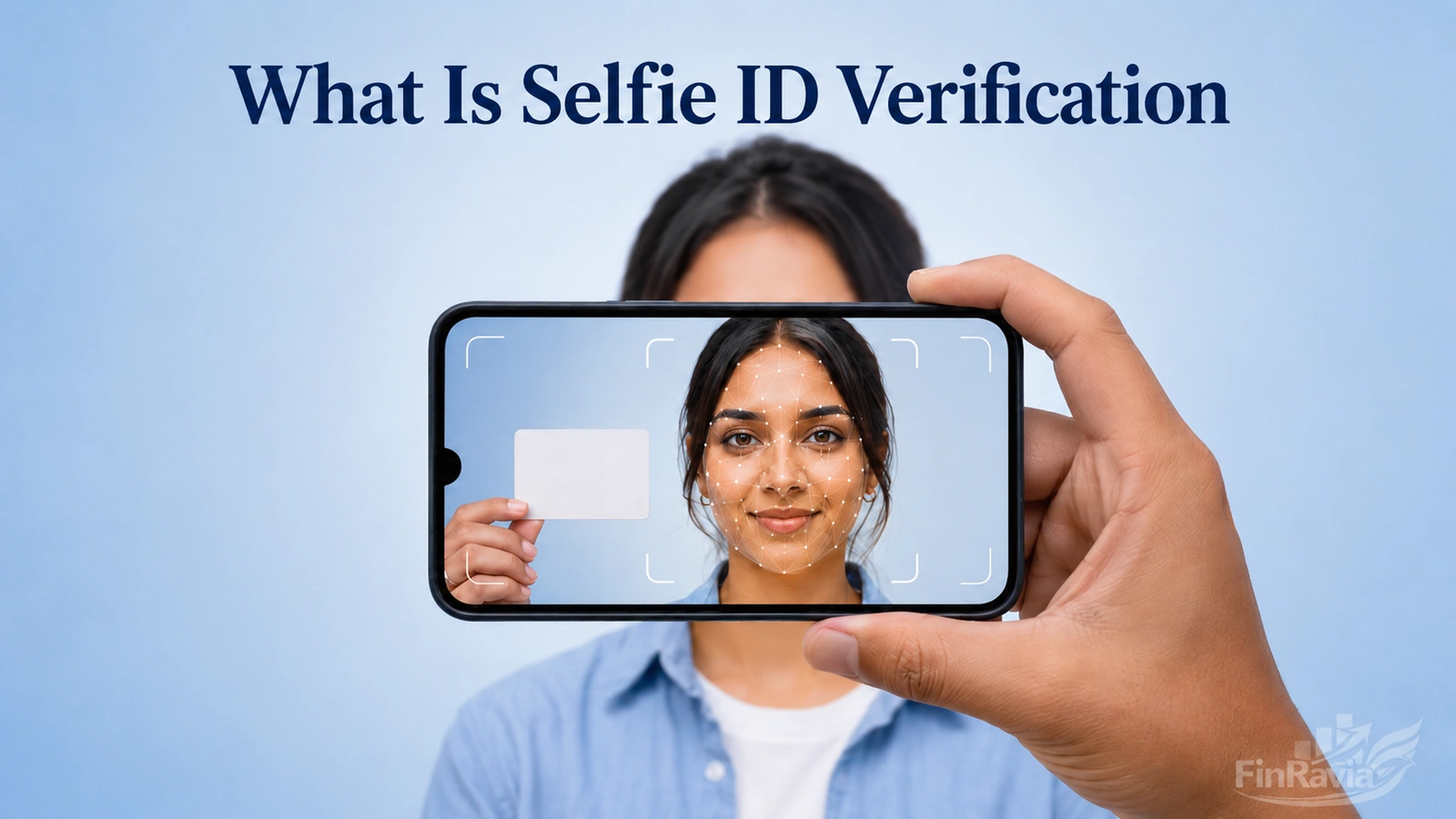
Selfie ID verification pairs a photo of your government-issued ID with a live selfie so a matching system can confirm the two faces belong to the same real, present person. Most banks, lenders, and fintech apps now require this step before opening an account or approving a loan.
Contents
What Is Selfie ID Verification?
Selfie ID verification is a two-part identity check: you photograph a government-issued ID, then take a live selfie for a real-time face match. The matching software compares the face on the document to the face in front of the camera, and the system also runs a liveness check to confirm the selfie is coming from a real, present person rather than a photo, video, or mask held up to the lens. Financial platforms — including many of the banks, lenders, and fintechs compared on Finravia — use this combination because a document alone only proves the ID exists; pairing it with a live face proves the applicant is the person the document belongs to.
The process sits inside a broader category called identity proofing. Definitions vary slightly by industry, but the core idea is the same everywhere it appears: confirm real-world existence, then confirm the applicant in front of the screen is that same person. Depending on the platform, that idea plays out through the same basic sequence of steps.
How the Process Works
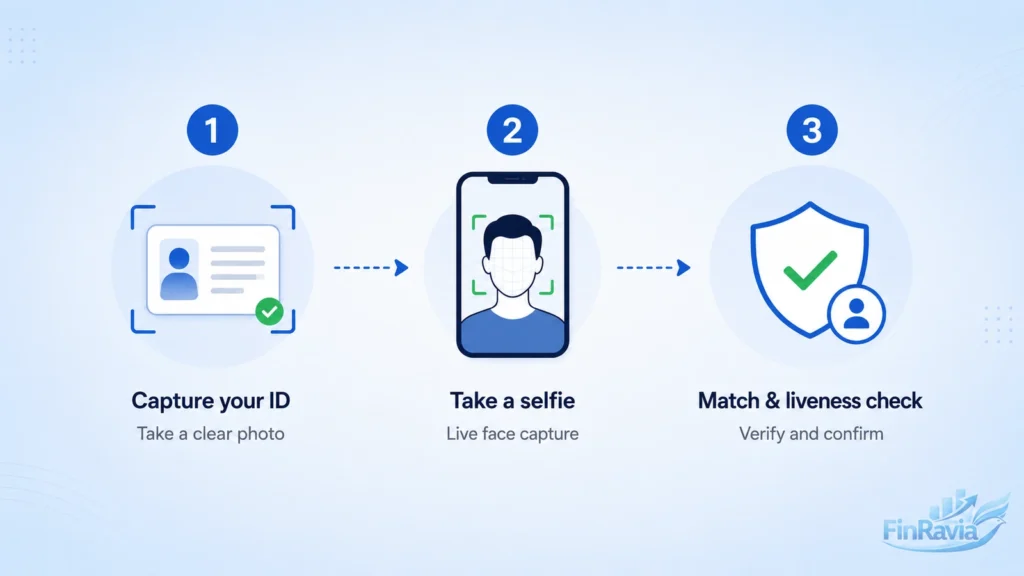
Most selfie ID verification flows follow the same sequence: capture the ID, take a selfie, then match the two and check liveness. This applies whether you’re opening a bank account, applying for a loan, or verifying a dating profile.
- Capture the ID. You photograph the front (and usually the back) of a driver’s license, passport, or national ID card. Optical character recognition and document-authentication checks read the data and look for signs of tampering.
- Take a live selfie. You look into the camera, and in many flows you’re asked to blink, turn your head, or follow an on-screen prompt.
- Match and verify liveness. An algorithm compares facial geometry between the ID photo and the selfie, while a separate liveness model checks for depth, texture, and motion cues that a flat photo or screen replay can’t reproduce.
Liveness detection comes in two forms. Active liveness detection asks you to perform an action — blink, smile, turn your head — and checks that your response matches the prompt. Passive liveness detection analyzes the video or image feed in the background, without asking you to do anything, looking at texture, light reflection, and depth. Passive checks feel faster and less intrusive; active checks tend to resist certain spoofing attempts more directly because they require a real-time response. Whether you notice the mechanics or not, financial platforms adopt this sequence for a specific legal reason.
Why Financial Apps and Lenders Require It
In the United States, selfie ID verification exists mainly because financial institutions are legally required to know who their customers are. The Customer Identification Program (CIP) rule — issued in 2003 under Section 326 of the USA PATRIOT Act and enforced under the Bank Secrecy Act — requires banks, credit unions, and other covered institutions to maintain risk-based procedures that let them form “a reasonable belief” that they know each customer’s true identity before opening an account. A selfie compared against an ID is one of the ways institutions satisfy that requirement for accounts opened online rather than in a branch.
The technical side of that requirement is shaped by NIST Special Publication 800-63A, the federal government’s digital identity guidelines. NIST defines three Identity Assurance Levels — IAL1, IAL2, and IAL3 — that describe how much confidence an identity-proofing process provides. At IAL2, the level most consumer financial services target for remote onboarding, an applicant’s identity evidence must be validated against an issuing authority, and the process must include either an automated biometric comparison (the selfie-to-ID match) or a live visual check by a trained agent, along with liveness detection to resist presentation attacks. IAL3, the highest level, requires an in-person or closely supervised remote session — well beyond what a routine account opening needs. The exact mix of checks — and how it changes across a bank account, a credit card and a loan — is covered in Finravia’s identity verification guide for banks, cards, and loans.
Not to confuse: Identity verification, KYC, and CIP overlap but aren’t the same thing. Identity verification is the technical act of confirming a person’s identity — often via a selfie-to-ID match. KYC (“Know Your Customer”) is the broader compliance program that includes identity verification plus ongoing monitoring for suspicious activity. CIP is the specific, documented procedure a U.S. financial institution must follow to verify identity before opening an account. Selfie ID verification is one tool used to satisfy the identity-verification piece of both.
That said, understanding the legal requirement doesn’t answer the question most applicants actually ask: is this safe?
Is It Safe? How Liveness Detection Stops Fraud
⚠️A printed photo or a screen replay does not reliably pass a modern selfie ID check. Liveness detection is built specifically to catch presentation attacks — holding up someone else’s photo, a video, or a mask to the camera — by analyzing depth, texture, and motion that a flat image can’t reproduce. That said, “liveness detection” is not a guarantee against every attack: increasingly realistic AI-generated video (deepfakes) is a genuine and evolving challenge that vendors continue to update their models against, which is why liveness checks are typically paired with document authentication and database matching rather than used alone.
For the applicant, the practical safety questions usually come down to two things: what the system does with your photos (covered below, in Methodology & Data Privacy), and whether the check itself can be tricked. On the second point, well-implemented systems combine several independent signals — document authenticity, facial match score, and liveness — so that beating one check isn’t enough to pass the whole process. However, a selfie check is only one of several ways financial platforms confirm identity.
How It Compares to Other Identity-Proofing Methods
Selfie ID verification isn’t the only way financial platforms confirm who you are, and it isn’t always the right tool for every situation.
- Selfie ID verification matches a live face to a photo ID in real time and usually finishes in under a few minutes. It works well for new-account and new-borrower onboarding, but it needs a working camera and a valid, legible ID.
- Micro-deposit verification confirms you own a bank account rather than confirming who you are — a service sends one or more small deposits, and you confirm the amounts. It’s common for linking an existing account to a payment app or setting up recurring payments, but on its own it doesn’t verify identity and typically takes one to three business days rather than minutes.
- Knowledge-based verification asks questions pulled from your credit history or public records. It’s fast and camera-free, but it can be defeated by anyone who has access to that same data about you, which is why NIST guidance treats it as weaker supporting evidence rather than a stand-alone method at higher assurance levels.
- In-person verification — an agent checks your ID face-to-face — offers the strongest assurance level but obviously isn’t practical for most online financial services.
Most financial platforms layer more than one of these methods depending on the size of the account, the loan amount, or the applicant’s risk profile, rather than relying on a single check. Even well-implemented layered checks occasionally reject a legitimate applicant, which is why it helps to know what a failure actually means.
When Selfie Verification Fails — and What Not to Assume
A failed selfie check doesn’t necessarily mean fraud was detected; it usually means one specific, fixable condition wasn’t met.
- The ID photo is a match failure, not a fraud flag, if glare or a bent corner hides the data fields — retake the photo flat, in indirect light, with all four corners visible.
- An expired ID will be rejected by document-authentication checks even if the face matches perfectly — most flows require a currently valid document, not just a recognizable one.
- A legal name change not yet reflected on your ID can cause a data mismatch even when the face matches — this needs to be resolved with updated documentation, not repeated selfie attempts.
- Camera permission blocks or a low-light selfie can trigger a liveness failure that looks identical to a spoofing rejection — check device permissions and lighting before assuming the system flagged you as fraudulent.
- Passing the selfie check does not by itself guarantee loan approval or account opening — identity verification confirms who you are; a lender’s underwriting decision still depends on separate creditworthiness and risk criteria.
So always treat a failed check as a data problem first, not an accusation — and here’s how I verified the claims in this guide.
Methodology, Sources & Data Privacy
Editorial process: I checked the regulatory claims in this article against NIST Special Publication 800-63A (Digital Identity Guidelines: Enrollment and Identity Proofing) and FinCEN’s published Customer Identification Program Rule guidance on 2026. Vendor-specific processing times and feature availability vary by provider and were described generally rather than attributed to any single company.
What happens to your selfie and ID photo depends on the provider a given financial platform uses, so always check that provider’s specific privacy notice before submitting documents. In general, reputable identity-verification vendors encrypt data in transit and at rest, retain it only as long as required for compliance and dispute resolution, and use it solely to complete the verification you requested — not for unrelated marketing. If a request for a selfie-with-ID comes from an unexpected email, text, or social-media message rather than inside a service you already use, treat it as a likely scam rather than a routine verification step.
This article explains how selfie ID verification generally works and does not constitute financial or legal advice. Specific requirements, processing times, and privacy practices depend on the financial institution and verification vendor involved.
In general, the most common follow-up questions are answered below.